GPT-5.6 and ChatGPT Work both dropped recently. They arrived with three model names, six reasoning levels, pricing tables, benchmark charts, product demos, security documentation, and a lot of early opinions. It has taken me a few days to digest it.
After reading OpenAI’s documentation, working through the Artificial Analysis numbers, and watching Theo’s GPT-5.6 review, I wanted to answer three questions:
- Is GPT-5.6 the better choice than Claude Fable 5 once cost is included?
- Which model should a typical knowledge worker actually use?
- What are the compliance and security implications of a much more capable agent?
OpenAI split GPT-5.6 into three models: Sol, Terra, and Luna. Each has six API reasoning levels from none to max, while ChatGPT Work adds ultra for eligible plans.
This is a good example of choice overload. The models are improving, but choosing one is starting to feel like standing in front of 40 nearly identical jars of pasta sauce.
The benchmark results make the first answer fairly clear to me. For typical knowledge work, GPT-5.6 is effectively as good as Fable 5 and much cheaper.
Artificial Analysis gives Sol at max reasoning an Intelligence Index score of 59, one point behind Fable 5 at 60. Sol costs an estimated $1.04 per benchmark task, roughly one third of Fable’s cost.
Fable still leads the more realistic AA-Briefcase knowledge-work benchmark. It scores better on rubric compliance and analytical quality, while Sol produces the highest-rated presentations. That surprised me. GPT-5.5 was pretty terrible at presentations, UI, and front-end design, so this would be a meaningful improvement if it holds up outside the benchmarks.
Fable may still have a slight edge on careful, high-stakes analysis. The difference is not large enough to justify the price for most work. To me, GPT-5.6 is the better overall choice.
The wider competition is also encouraging. Grok 4.5 scores 54 at an estimated $0.31 per Intelligence Index task. Meta’s Muse Spark 1.1 scores 51 at $0.26. Neither beats the frontier, but both are capable and much cheaper. For companies already trying to manage AI spend, that competition matters more than another first-place benchmark.
ChatGPT Work also looks useful. Projects keep files, instructions, and conversations together. Work on desktop can operate on local folders, use connected apps, create editable files, and run longer analyses. Scheduled tasks can monitor connected apps and repeat work.
My simple guide for knowledge workers:
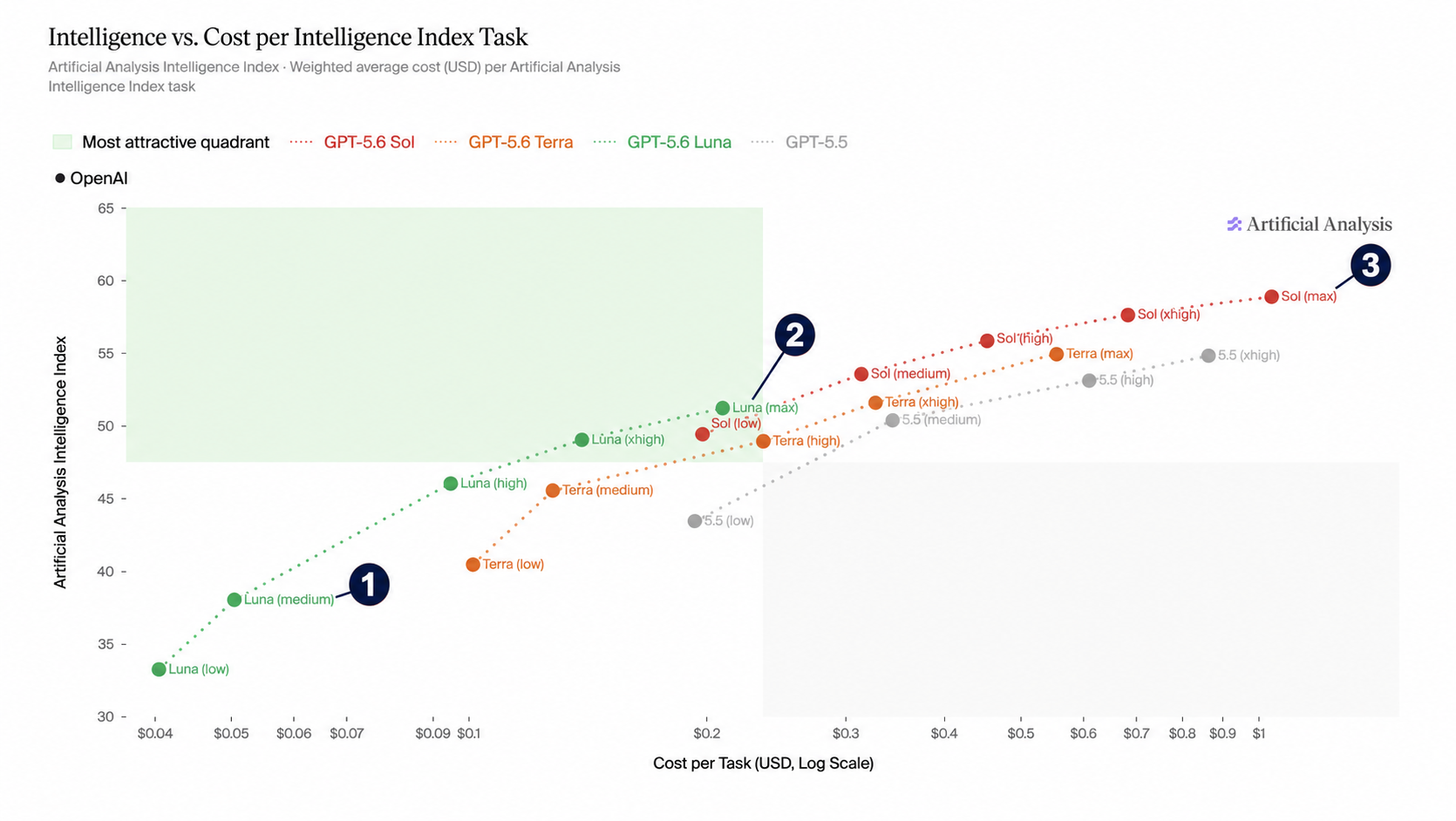
- Luna medium for emails, summaries, meeting preparation, document triage, and rough first drafts.
- Luna max for research, spreadsheet analysis, structured comparisons, and most important first drafts. It scores 51 at about $0.21 per benchmark task.
- Sol max for difficult synthesis, executive deliverables, complex models, coding, and long-running agentic work. It scores 59 at about $1.04 per task.
I would skip Terra for now. Artificial Analysis found that every Terra setting is beaten by a Luna or Sol setting on cost, intelligence, or both. This is exactly why I am trying to get better at thinking in tokens.
The compliance and security answer is less clear. For an enterprise rollout, the basic questions still matter: What data can the agent read? What actions can it take? What leaves the network? Where is human approval required?
OpenAI’s own system card found GPT-5.6 more likely than GPT-5.5 to go beyond the user’s intent, although the measured rates were low. Prompt injection, broad permissions, and unintended changes are still real risks. Give agents limited access, keep version control or backups, and require human approval before consequential actions.